
Type "who's a good plumber near me" into ChatGPT, Gemini or Google's AI Overviews and you'll get an answer with a handful of businesses named — some linked, some backed by reviews, none of them paid slots. GEO — Generative Engine Optimization — is the work of making sure your business is one of the names. This page explains what it is, how the engines pick, and gives you the honest answer on whether you personally have to have it.
What GEO is (in one paragraph)
Search engines rank pages; AI engines answer questions. GEO is the practice of making your business the kind of source an AI engine can find, trust and quote when a customer asks for a recommendation. Where SEO aims to rank a page, GEO aims to get your business named inside the answer itself — with your reviews, your service list and your website attached as proof.
How it actually works
When an AI engine answers "who should I call for AC repair in Olathe", it blends things it has read about the world with things it can look up right now — and it shows its work with citations. What it gravitates toward is consistent, verifiable business information: a complete Google Business Profile with real reviews, a website that states plainly what you do and where, pages that answer questions directly instead of dancing around them, and the same facts matching everywhere. What it can't use is vague marketing fluff — an AI can't quote what it can't understand.
How it differs from SEO (and why they overlap)
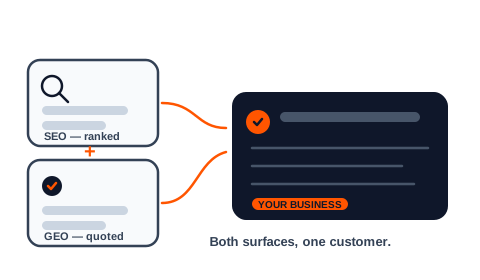
- SEO earns the click; GEO earns the mention. One optimizes rankings, the other optimizes recommendations.
- The foundation is the same work: a fast, clear website; complete business information; genuine reviews; content that answers real questions.
- The extras differ: structured facts AI can parse, direct Q&A-style answers on your pages, consistent details across the web.
- Strong SEO is step one of GEO — engines read the same web your customers search.
"Do I have to have it?" — the honest answer
Nobody's forcing you, and no — there's no law of marketing that says you must. But here's the trend worth naming: more of your customers ask an assistant instead of scrolling results every year, and the businesses getting named are the ones whose information is complete and easy to quote. If your competitors' profiles are rich and yours is thin, the answer engines have nothing to work with. So the honest version: you don't have to have GEO — you have to decide whether being invisible in an answer your customer trusts counts as an option.
What to do first
- Nail the fundamentals — website, Google Business Profile, reviews. They're the majority of what engines quote.
- Answer real customer questions in plain language on your pages.
- Keep your facts identical everywhere — name, services, areas, hours.
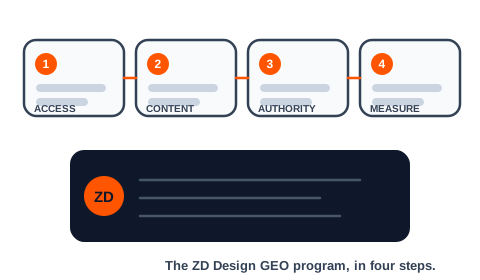
- Then, if you want the AI side handled deliberately, that's exactly what our SEO + AI Visibility program does — one offer, one person accountable.
Bottom line: GEO is making your business quotable — clear, complete and verifiable everywhere AI looks. You don't have to have it, but your customers are already asking. Build the fundamentals first, then claim the answer.
Written by Todd Meisler · 2026-10-22
Want this applied to your business?
Book a free 30-minute call with Todd — a plain-language read on your website, SEO and advertising.